
Deadlines are scary in the publishing world. If you miss a launch date for a religious holiday or a big conference, you lose sales that you cannot get back. The pressure to deliver high-quality Bibles or journals on time is very real.
Managing lead times requires a backwards planning approach, starting from the delivery date and factoring in 30-45 days for production plus shipping. Key elements include finalizing file proofs early, accounting for special material sourcing like Bible paper or leather, and buffering time for complex finishing processes like edge gilding and ribbon insertion.

Understanding the production timeline is not just about dates. It is about understanding the process. When you know how we make your books, you can plan better. Let me explain how we handle this at Panoffices to keep your project on track.
How Does Material Selection Impact the Production Schedule?
You want your religious publications to look and feel premium. But choosing rare materials can slow down the whole project if you are not careful.
Standard materials are often in stock, but custom colors, specific GSM Bible paper, or special faux leather require an extra 15-20 days for sourcing. To keep schedules tight, approve material swatches digitally or use available stock options if the timeline is short.
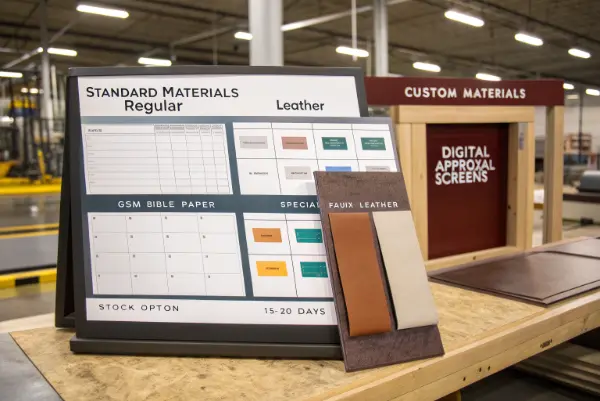
When we talk about religious publications, we are usually talking about very specific materials. You are not just printing on standard copy paper. You usually want thin "Bible paper" or high-end PU leather for the cover. This is where the timeline often breaks down.
I remember a project I handled for a client in Europe last year. He wanted a very specific shade of burgundy for the cover of a prayer journal. It was a beautiful color. However, that specific color was not in our standard stock. We had to order the raw material from the leather factory, and they had to dye it specifically for this order. This added 15 days to the start date before we could even begin cutting the covers.
The Challenge of Bible Paper
Using thin paper (often 30gsm to 50gsm) is common for Bibles and thick devotionals. This paper is special.
- Sourcing: We do not always keep tons of this paper on the floor. We order it fresh to ensure humidity levels are correct.
- Printing: This paper is delicate. The printing machines must run slower to prevent tearing. If we rush this, the paper tears, and we have to start over.
Custom Molds and Embossing
If you want a custom logo debossed (pressed in) or a metal foil stamp, we need to make a metal mold.
- Mold Making: Takes 3-5 days.
- Testing: We test the heat and pressure on the specific leather you chose.
If you choose materials that are "in stock," we can start immediately. If you choose "custom," you must add weeks to your plan. It is a trade-off between exact design and speed.
| Material Type | Sourcing Time | Risk Level for Delay |
|---|---|---|
| Stock PU Leather | 1-2 Days | Low |
| Custom Dyed Leather | 15-20 Days | High |
| Standard Offset Paper | 2-3 Days | Low |
| Specialty Bible Paper | 10-15 Days | Medium |
| Custom Metal Charms | 15-20 Days | High |
Why Do Special Finishes Add Time to Manufacturing?
A plain book is fast to make. But a religious book often has gold edges, ribbons, and round corners. These steps take time.
Special finishes like foil stamping, edge gilding, and round cornering require separate machine setups and manual handling. Each additional finish adds 3-5 days to the production cycle because the ink and glue must dry completely between steps to prevent defects.
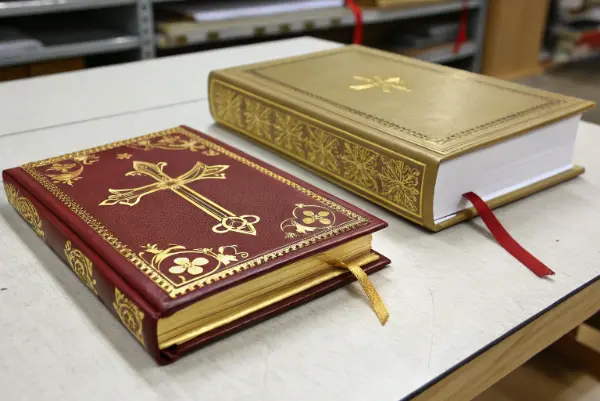
In the stationery business, we call these "post-press finishes." This means everything that happens after the ink hits the paper. For religious publications, this list is usually long. You might want round corners, a ribbon marker, an elastic band, a pocket in the back, and gold foil on the page edges.
The Reality of Drying Time
You cannot rush chemistry. Glue needs time to dry. Ink needs time to set.
When we make a hardcover book, we glue the paper block to the cover (casing in). If we pack the books into boxes immediately while the glue is wet, the moisture gets trapped. This causes the pages to wave or warp. We need to let the books "rest" under pressure for at least 24 hours.
The Complexity of Edge Gilding
Gilding is when the edges of the pages are gold or silver. This is a very sensitive process.
- Sanding: The edges must be perfectly smooth.
- Application: The foil is applied with heat.
- Separation: Sometimes pages stick together slightly and need to be checked.
Ribbon Markers
Inserting ribbons is often done by hand or by semi-automatic machines. If you want two or three ribbons in different colors (common for Bibles), this slows down the binding line significantly. A machine might do 30 books a minute with one ribbon, but only 10 books a minute with three ribbons.
I always tell my clients: "Complexity costs time." If you need the books in 30 days, we might need to remove the edge gilding. If you have 60 days, we can do everything you want.
| Process | Estimated Time Added | Why? |
|---|---|---|
| Round Corners | +2 Days | Requires cutting and sanding. |
| Edge Gilding | +4-5 Days | Sanding, heating, cooling, checking. |
| Multiple Ribbons | +2-3 Days | Slower insertion speed. |
| Elastic Band | +2 Days | Manual assembly or specialized machine. |
When Should You Start Planning for Holiday-Specific Releases?
Christmas and Easter come at the same time every year. Yet, we see panic orders every October. This is risky.
You should start the design and inquiry phase at least 4 to 5 months before your target launch date. This allows 1 month for sampling and revisions, 45 days for mass production, and 30-40 days for sea freight and customs clearance.

Working backwards is the only way to be safe. Let’s say you want to sell a new prayer journal for the Christmas season. You want it in your warehouse by November 1st so you can ship it to stores.
Many people think, "Production takes 40 days, shipping takes 30 days, so I will order in August." This is a mistake. This calculation forgets the most time-consuming part: The Pre-Production Phase.
The Sampling Trap
Before we print 5,000 copies, we must make a sample.
- You send the file.
- We check the file (1-2 days).
- We make a digital proof (1-2 days).
- We make a physical sample (7-10 days).
- We ship the sample to you (3-5 days).
- You review it. You find a typo. You want to change the cover color.
- We make a second sample (another 7-10 days).
Suddenly, a month has passed. If you did not plan for this, your November delivery becomes a December delivery, and you miss the holiday sales.
The Logistics Buffer
Shipping is unpredictable. I have seen ships delayed by storms. I have seen containers stuck in customs for routine checks.
- Sea Freight: Usually 30-35 days to Europe or USA.
- Customs: usually 3-5 days, but can be 10 days.
- Trucking: getting it from the port to your door.
You need a buffer. A buffer is extra time you save for problems. If everything goes perfect, you get your goods early. That is great. But if something goes wrong and you have no buffer, you are in trouble.
Critical Path for a November 1st Delivery
| Action Step | Ideal Date |
|---|---|
| Start Design / Inquiry | June 1st |
| Finalize Sample & Order | July 15th |
| Mass Production Start | August 1st |
| Production Finish | September 15th |
| Ship from Port | September 20th |
| Arrive at Destination | October 25th |
| Deliver to Warehouse | November 1st |
How Does Rigorous Quality Control Prevent Major Delays?
You might think checking quality slows things down. Actually, it speeds things up by preventing disasters.
Integrated Quality Control (IQC) at raw material intake and In-Process Quality Control (IPQC) during binding prevent mass defects. While thorough inspections add 2-3 days to the timeline, they eliminate the risk of needing a full reprint, which would cause a delay of months.
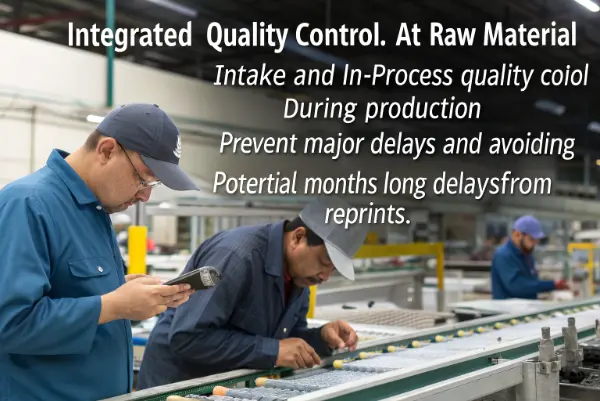
Nobody likes delays. But do you know what is worse than a one-week delay? Receiving 5,000 books that are printed upside down. Or receiving journals where the cover falls off.
If we ship bad products, the delay is not weeks. The delay is months because we have to buy new paper, reprint, rebind, and reship. That is why quality control (QC) is part of the schedule.
The "Golden Sample"
Before we turn on the big machines, we make one perfect copy. We call this the Golden Sample. The production manager signs it. The QC manager signs it.
Every worker on the line looks at this sample. It sets the standard. If the ink looks different than the Golden Sample, they stop the machine.
Checkpoints Save Time
We do not wait until the end to check. We check at every step.
- Paper Check: Is the grain direction correct? (Wrong grain makes pages hard to turn).
- Print Check: are the colors consistent?
- Binding Check: Is the glue strong enough?
- Final Check: Is the cover clean?
I once had a factory partner who skipped the "glue test" to save one day. They shipped the books. Two weeks later, the client complained that the pages were falling out in the cold weather. We had to replace everything. It was a disaster.
Now, at Panoffices, we schedule time for "aging tests." We put the finished book in a hot oven and a cold freezer to make sure the glue holds. This takes 2 days. But it ensures that when your customer opens the book, it stays together.
Third-Party Inspections
Some of our clients send a third-party inspector to our factory before we ship. We welcome this. It adds about 1 or 2 days to the timeline for the inspection and the report. But it gives you peace of mind. You know the goods are good before they get on the boat.
| QC Stage | What We Look For | Time Impact |
|---|---|---|
| IQC (Incoming) | Paper brightness, Leather color, Glue quality | 1 Day |
| IPQC (In-Process) | Printing clarity, Folding accuracy, Sewing strength | 0 Days (Done during work) |
| FQC (Final) | Cleanliness, Accessories, Packaging | 1-2 Days |
| Lab Testing | Glue durability (Hot/Cold), Binding strength | 2 Days |
Conclusion
Managing lead times for religious publications is about balancing quality with speed. You must plan backwards from your deadline, allowing time for custom materials, complex finishes, and strict quality checks. By starting early and understanding the production steps, you ensure your project arrives on time and meets the high standards your customers expect.
